
Free Exam
The Shadow in the Corner
Michael Bascom retired later than usual that night. He was in the habit of sitting at his books long after every other lamp but his own had been extinguished. Tonight his studies were of a peculiarly interesting kind, and belonged to the order of recreational reading rather than of hard work.
The old eight−day clock on the stairs was striking two as Michael slowly ascended, candle in hand, to the hitherto unknown region of the attics. At the top of the staircase he found himself facing a dark narrow passage which led northwards, a passage that was in itself sufficient to strike terror to a superstitious mind, so black and uncanny did it look.
He opened the door of the north room, and stood looking about him. It was a large room, with a ceiling that sloped on one side, but was fairly lofty upon the other; an old−fashioned room, full of old−fashioned furniture—big, ponderous, clumsy—associated with a day that was gone and people that were dead. A walnut−wood wardrobe stared him in the face—a wardrobe with brass handles, which gleamed out of the darkness like diabolical eyes. There was a tall four−post bedstead, which had been cut down on one side to accommodate the slope of the ceiling, and which had a misshapen and deformed aspect in consequence. There was an old mahogany bureau that smelt of secrets. There were some heavy old chairs with rush bottoms, mouldy with age, and much worn. There was a corner washstand, with a big basin and a small jug—the odds and ends of past years. Carpet there was none.
“It is a dismal room,” mused Michael.
To him it mattered nothing where he slept. He went to bed, determined to sleep his soundest. The bed was comfortable, well supplied with blankets, rather luxurious than otherwise, and he felt that agreeable sense of fatigue which promises profound and restful slumber.
He dropped off to sleep quickly, but woke with a start ten minutes afterwards. What was this consciousness of a burden of care that had awakened him—this sense of all−pervading trouble that weighed upon his spirits and oppressed his heart—this icy horror of some terrible crisis in life through which he must inevitably pass?
Adapted from: The Shadow in the Corner
Mary Elizabeth Braddon (1835-1915)
Quiz Summary
0 of 26 Questions completed
Questions:
Information
You have already completed the quiz before. Hence you can not start it again.
Quiz is loading…
You must sign in or sign up to start the quiz.
You must first complete the following:
Results
Results
0 of 26 Questions answered correctly
Your time:
Time has elapsed
You have reached 0 of 0 point(s), (0)
Earned Point(s): 0 of 0, (0)
0 Essay(s) Pending (Possible Point(s): 0)
Categories
- Comprehension – Finding information 0%
- Comprehension – Identifying the Main Idea 0%
- Comprehension – Inference 0%
- Comprehension – Meaning of words 0%
- English – Awkward Spellings 0%
- English – Parts of Speech 0%
- English – Similes and Metaphor 0%
- Maths – Algebra – Solving equations 0%
- Maths – Area Compound Shapes 0%
- Maths – Converting standard units 0%
- Maths – Ratio – Word Problems 0%
- Maths – Time / Duration Problems 0%
- Maths – Volume 0%
- Maths – Word Probs Mixed Operations 0%
- VR – Antonyms (Opposite Meanings) 0%
- VR – Compound Words 0%
- VR – Making deductions from information 0%
- VR – Synonyms 0%
- Review / Skip
- Answered
- Correct
- Incorrect
-
Question 1 of 26
1. Question
Find the two words, one from each group, which are closest in meaning.
(celebration, dedication, permanent) (dignity, extravagance, commitment)
CorrectIncorrect -
Question 2 of 26
2. Question
Find the two words, one from each group, which are closest in meaning.
(riches, starvation, decay) (royal, wealth, debt)
CorrectIncorrect -
Question 3 of 26
3. Question
Find two words, one from each group, that go together to form a new word. The word in the first group always comes first.
-
(now hide all) (seek so here) The new word is:
CorrectIncorrectHint
The sounds at the beginning or end of a word may change when they are combined with other words.
-
-
Question 4 of 26
4. Question
Find two words, one from each group, that go together to form a new word. The word in the first group always comes first.
-
(ran bore up) (dome ring lift) The new word is:
CorrectIncorrect -
-
Question 5 of 26
5. Question
Which combination of letters can be added to the letters on the right to make a word with an opposite meaning to the word on the left?
lasting TE_P_R_R_
CorrectIncorrect -
Question 6 of 26
6. Question
Which combination of letters can be added to the letters on the right to make a word with an opposite meaning to the word on the left?
unsatisfactory _C_E_T_BLE
CorrectIncorrect -
Question 7 of 26
7. Question
Stella is Grace’s daughter and Sophia’s sister. Aaron is Sophia’s father and Charlie’s son.
From these statements, select the only statement which must be true.
CorrectIncorrect -
Question 8 of 26
8. Question
In this sentence, mistakes may have been made in the use of spelling. You must identify the mistake, or decide if no mistake has been made.
It is particularly importent for children to eat a healthy diet and take plenty of exercise.
CorrectIncorrect -
Question 9 of 26
9. Question
In this sentence, mistakes may have been made in the use of spelling. You must identify the mistake, or decide if no mistake has been made.
The rocket was propelled several miles into the aire and finally disappeared above the clouds.
CorrectIncorrect -
Question 10 of 26
10. Question
Why did Michael Bascom go to bed later than usual this evening?
CorrectIncorrect -
Question 11 of 26
11. Question
What time did Michael Bascom go to bed?
CorrectIncorrect -
Question 12 of 26
12. Question
Which of the following items were not found in the bedroom?
CorrectIncorrect -
Question 13 of 26
13. Question
Which of the following best describes the way Michael felt about the room?
CorrectIncorrect -
Question 14 of 26
14. Question
For what reason was Michael reading?
CorrectIncorrect -
Question 15 of 26
15. Question
Which of the following phrases contains a simile?
CorrectIncorrect -
Question 16 of 26
16. Question
Which word is most similar to the word “lofty” (paragraph 3) in the context of the passage?
CorrectIncorrect -
Question 17 of 26
17. Question
Which of the following statements is true?
CorrectIncorrect -
Question 18 of 26
18. Question
Which of the following is an antonym for “agreeable” (paragraph 5)?
CorrectIncorrect -
Question 19 of 26
19. Question
What type of word is “accommodate” (paragraph 3)?
CorrectIncorrect -
Question 20 of 26
20. Question
1560 people attended a talk entitled: Magic in the Wizarding World. 55% of the audience were children. Two eighths were men. How many women attended the talk?
CorrectIncorrect -
Question 21 of 26
21. Question
During the summer holidays Jamie and Elsie are attending a sports camp for three hours every morning. The morning is broken into three parts with two breaks in between as follows:
- Fitness Training
- Refreshment break
- Tennis
- Refreshment break
- Mini Games
The ratio of the duration of the sessions is 2 : 1 : 3 : 1 : 3
What is the total time of the refreshment breaks?
CorrectIncorrect -
Question 22 of 26
22. Question
2k – 17 = 13
k = ?
CorrectIncorrect -
Question 23 of 26
23. Question
A train leaves London at 7.34 a.m. and arrives in Edinburgh at 10.19 p.m.
How long does the journey take?
CorrectIncorrect -
Question 24 of 26
24. Question
One pound is 1.15 Euros.
How many pounds in 92 Euros?
CorrectIncorrect -
Question 25 of 26
25. Question
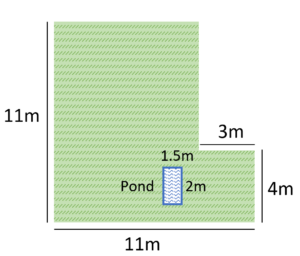
This is a plan of Mr and Mrs Patel’s garden. It is not drawn to scale.
Calculate the area of the lawn.
CorrectIncorrect -
Question 26 of 26
26. Question
This is a plan of Mr and Mrs Patel’s garden. It is not drawn to scale.
The pond is 1.5 metres deep.
What is the capacity of the pond when it is full?
CorrectIncorrect